
Why SAP DRC is Re-Writing the Rules of Global Tax
For the modern global enterprise, managing tax compliance has historically been a fragmented, high-risk nightmare. Tax departments have long operated as 'back-office cost centers,' struggling with a patchwork of country-specific ABAP programs, manual data extractions, and the constant threat of missing localized regulatory updates. As seismic shifts like the France 2026 mandate approach, the paradigm is shifting: tax compliance is no longer a period-end task, but a real-time prerequisite for business continuity.
SAP Document and Reporting Compliance (DRC) is the strategic response to this complexity. By moving beyond traditional reporting into a unified, digital-first framework, DRC allows the Tax department to transition from a reactive cost center to a proactive data-integrity gatekeeper, ensuring permanent Audit Readiness in an increasingly transparent world.
Takeaway 1: The Tax Authority is the New 'Source of Truth'
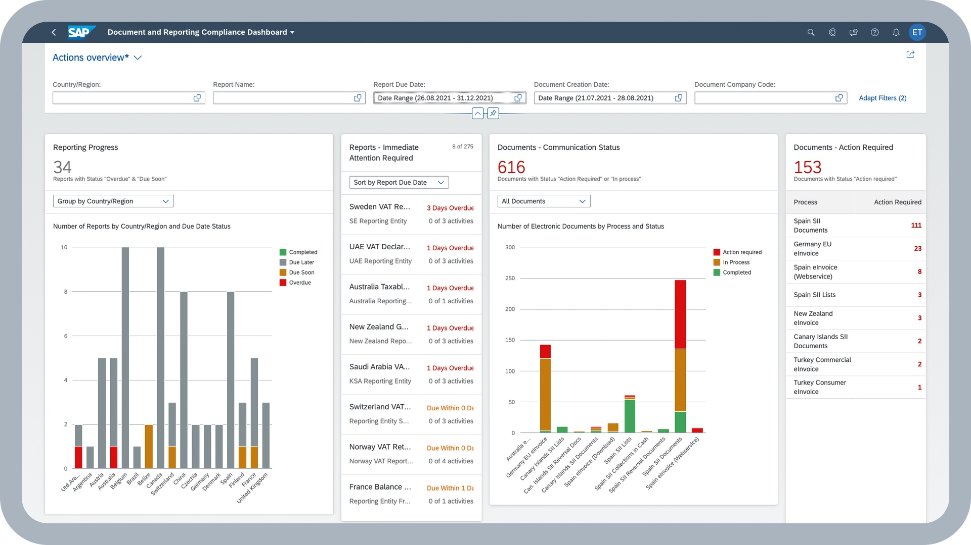
We are witnessing a global 'Digitalization Journey' where tax authorities are moving from 'E-filing' to 'E-clearance' and, ultimately, 'E-verification.' In this advanced stage, the traditional reporting roles are completely inverted: the authority pre-populates the tax return based on the transactional data they have already intercepted, and the taxpayer is left to reconcile errors.
Previously, internal company records were the definitive source of truth. Today, the digital files held by authorities (via e-clearance and distribution networks) represent the legal reality of the business. As the source material notes:
'The tax authorities' records become the source of truth, and they can prepare aggregated reports on behalf of the taxpayers.'
Takeaway 2: The Death of the ABAP 'Patchwork'
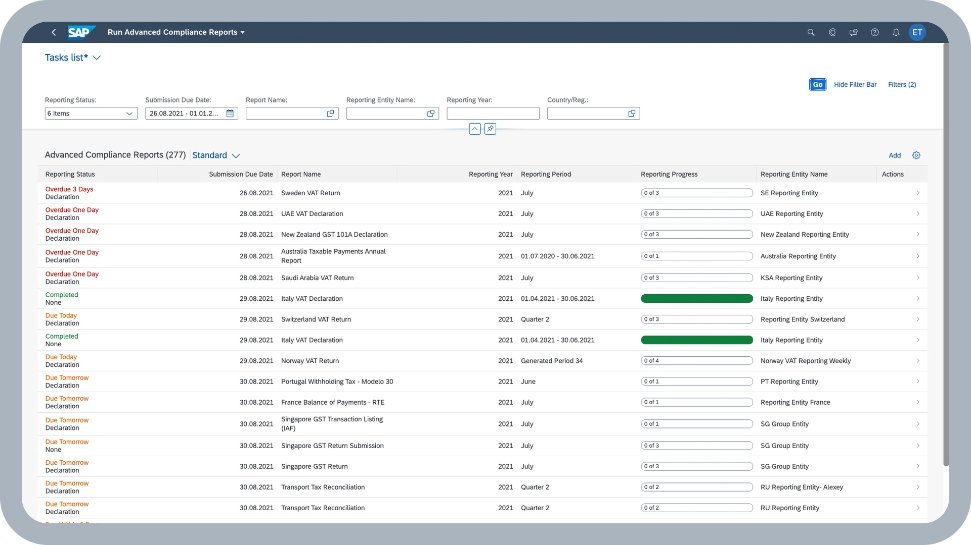
In legacy SAP ECC environments, compliance was often a 'patchwork' of custom tables and localized code that was expensive to maintain and nearly impossible to audit globally. SAP DRC replaces this fragmentation with a 'Single-frame Architecture.'
By providing a unified Fiori interface—the Run Statutory Reports App F1515—global enterprises gain a single cockpit for all mandates. Whether you are monitoring a VAT return in Germany or electronic invoicing in Romania, the user experience and monitoring framework are identical. This reduces the total cost of ownership (TCO) and ensures that global process owners have a standardized view of compliance status across every jurisdiction.
Takeaway 3: Real-Time or Bust—The France 2026 Mandate
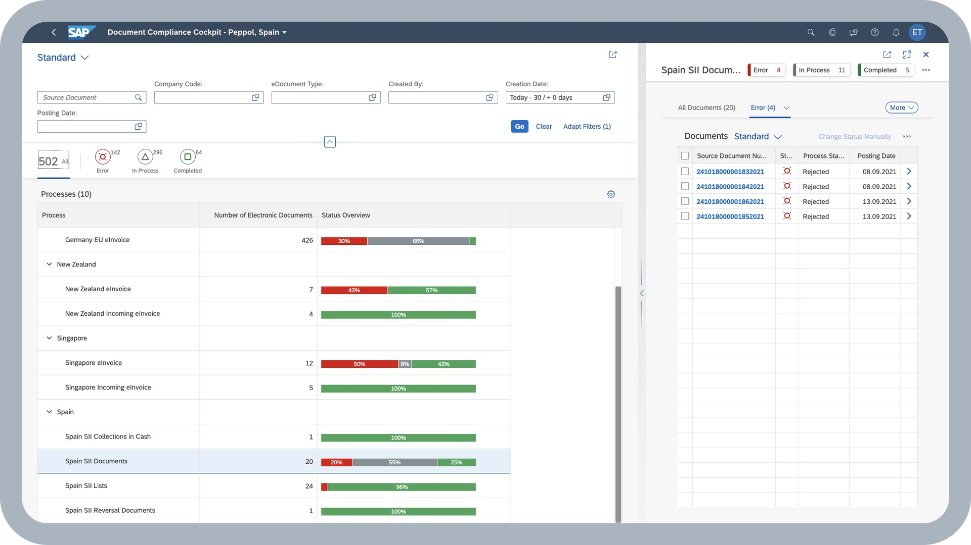
The upcoming 2026 mandate in France is not merely a reporting change; it is a fundamental shift in business operations. Compliance now happens in a real-time response loop through the Peppol Network. For organizations operating in France, the SAP DRC implementation must address:
- B2B Electronic Invoicing & e-Reporting: Creation, submission, and receipt of invoices with real-time status tracking (Accepted/Rejected).
- Master Data Integrity: Tax identification must now be precise, specifically accounting for SIRET (Tax Number 1 / FR1) and SIREN (Tax Number 2 / FR2).
- Statutory Requirements: Integration of the VAT Return and the FEC (Fichier des Écritures Comptables) report.
Consultant Insight: A successful transition requires a rigorous Analysis Phase. This involves utilizing a standardized 'Questionnaire' to map internal SAP values—such as Document Types and Tax Indicators—to the strict requirements of the Peppol network. This mapping is the foundation of data integrity.
Takeaway 4: The 'Single Source of Truth' (SST) within S/4HANA
A core technical pillar of SAP DRC is the elimination of data replication. Legacy systems often relied on 'mirror tables' or data replicas, which inevitably led to discrepancies between the General Ledger and the Tax Report. DRC adopts a Single Source of Truth (SST) philosophy by reading data directly from the source.
'DRC reads directly the financial documents (Journal Entries) and the billing documents (Invoice Documents) in real time... there are no discrepancies between what you post and what you report.'
This direct-read capability eliminates the need for manual reconciliations and ensures that the data being sent to the tax authority is always in sync with the financial core of the business.
Takeaway 5: The SAP Integration Suite as a Regulatory Buffer
To handle the rapid pace of government-driven technical changes, SAP DRC utilizes a modular architecture. The system is split between the Backend (S/4HANA) and the Cloud Edition (SAP Business Technology Platform - BTP).
- The Backend: Handles the complex extraction and mapping of business data logic.
- Cloud Edition & SAP Integration Suite: Acts as the communication engine. This layer manages the fast-evolving protocols, digital signatures, and security certificates required by local authorities.
This modularity provides a 'regulatory buffer,' allowing SAP to update communication standards in the cloud without forcing disruptive updates to the core ERP backend.
Takeaway 6: The Three Pillars of the 'Run Statutory Reports' Framework
The App F1515 framework organizes compliance into a clear, manageable hierarchy:
- Report Definition (The Technical Template): Contains the logic for field extraction and formatting (XML, JSON, TXT).
- Report Category (The Business Container): Links the technical template to specific organizational units, reporting phases, and organizational entities (VAT IDs).
- Reporting Activity (The Granular Steps): Defines the specific tasks for the user, such as 'Manage Tax Items' or 'Post Tax Payable.'
This framework's 'superpower' is its drill-down capability. Tax accountants can click on any figure within a generated report and trace it back to the original accounting document in real-time, enabling immediate verification and correction before the final submission.
Conclusion: The Future of Frictionless Tax
SAP DRC represents the evolution of tax from a back-office burden into an integrated, real-time business flow. By centralizing reporting, eliminating data replication, and leveraging the SAP Integration Suite to buffer against regulatory volatility, organizations can finally transition from a reactive posture to a strategic one.
In a world where the tax authority already has a copy of your transactional data in real-time, the question for business leaders is simple: Is your business ready to defend its data before the report is even filed?