
A Strategic Guide for the CFO in the SAP S/4HANA Era
1. Introduction: The 'Open Concept' of Modern Finance
In the field of space renovation, the 'open-concept' floor plan has transformed how we interact with our environment. By tearing down walls—especially those that, hopefully, are not load-bearing—between the kitchen and the dining room, it not only creates new lines of sight but radically optimizes communication and spatial flow.
This analogy accurately describes the transition from traditional SAP ERP to SAP S/4HANA. The previous modular-siloed architecture has been replaced by an open-concept structure where the Universal Journal acts as that large, integrated kitchen. The purpose of this guide is to explain how this new technical architecture is not simply an IT upgrade, but a strategic catalyst that accelerates the financial close and eliminates manual reconciliations, allowing financial management to move beyond data entry and focus on value analysis and risk mitigation.
2. The Heart of the Close: The Universal Journal (ACDOCA)
The most disruptive innovation in SAP S/4HANA is the ACDOCA table, the heart of the Universal Journal. This architecture establishes a 'Single Source of Truth' by consolidating into a single table what previously resided in separate ledgers for Financial Accounting (FI), Controlling (CO), Asset Accounting, and Material Ledger. This technical power makes it possible to process up to 999,999 line items in a single accounting entry, providing the organization with unprecedented 'Big Data' capabilities.
For a CFO, this unification translates into strategic benefits that directly impact the bottom line:
- Elimination of reconciliation by design: By unifying FI and CO, the need to reconcile legal accounting with analytical accounting disappears. Technically, secondary cost elements are now G/L accounts, eliminating any discrepancy between management and finance.
- Immediate multi-currency availability: All currencies required for local and corporate reporting reside in the same table, accelerating group consolidation.
- 360-degree visibility: Real-time access to balance sheets, profit and loss statements (P&L), and operational KPIs simultaneously, drastically reducing the days-to-close.
- Superior traceability and auditing: Allows deep drill-down capabilities from any balance sheet item back to the source document, minimizing compliance risk.
The ACDOCA table establishes a Single Source of Truth, unifying FI and CO to eliminate manual reconciliations by design.
3. Operational Efficiency: The SAP Financial Closing Cockpit
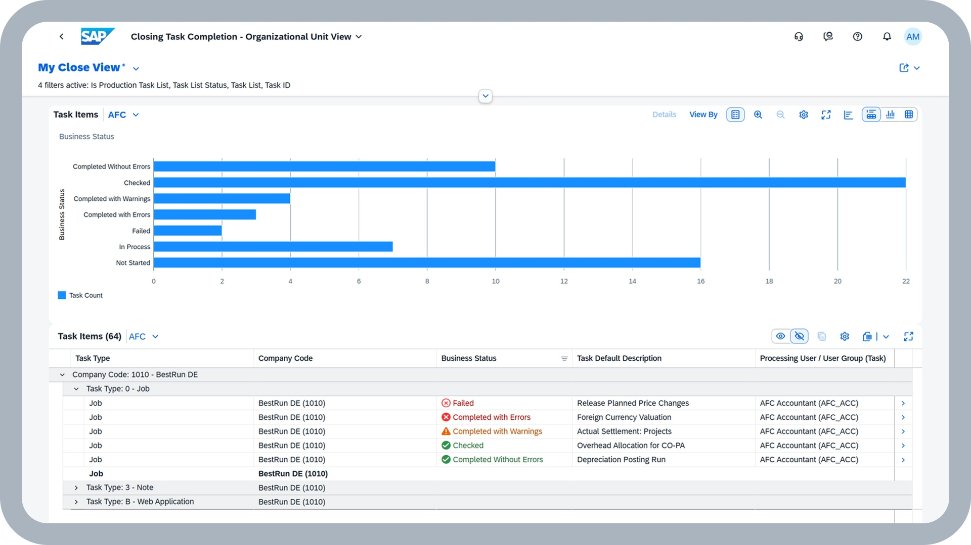
The financial close has evolved from a sequence of isolated tasks into a process orchestrated from a central control tower: the SAP S/4HANA Financial Closing Cockpit. This tool helps mitigate operational risks through real-time monitoring of every step of the close.
- Role: Finance Team Member: Performs manual tasks and supervises batch jobs. Features direct drill-down capabilities from the cockpit to the transaction level to fix errors instantly.
- Role: Financial Manager (CFO/Controller): Uses standardized templates to ensure closing consistency across all group entities, identifying the 'critical path' through GANTT charts.
- Agile Communication: Automatic notification to colleagues upon completing dependent tasks, eliminating dead waiting times.
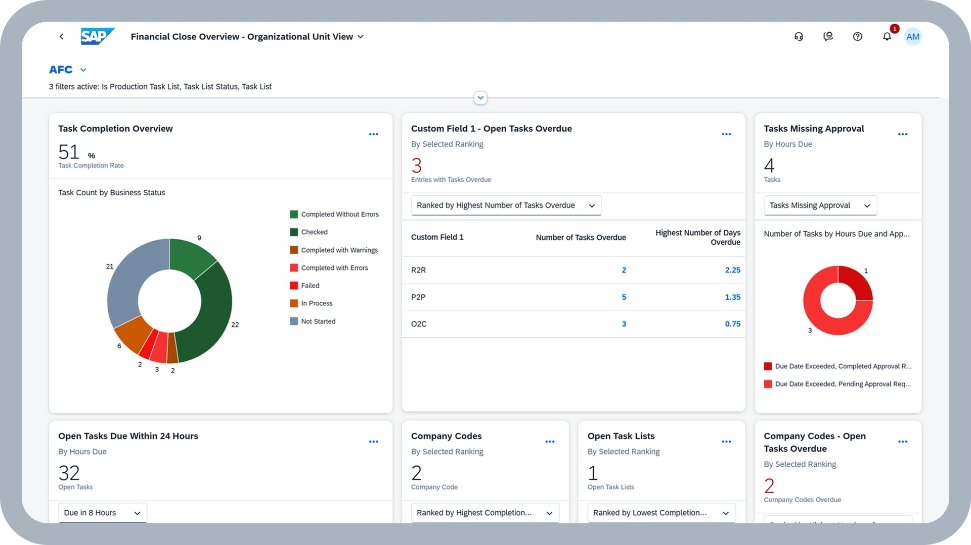
- Control via KPIs: Use of KPI Analytical Apps to monitor global progress and compare performance across different subsidiaries, detecting best practices.
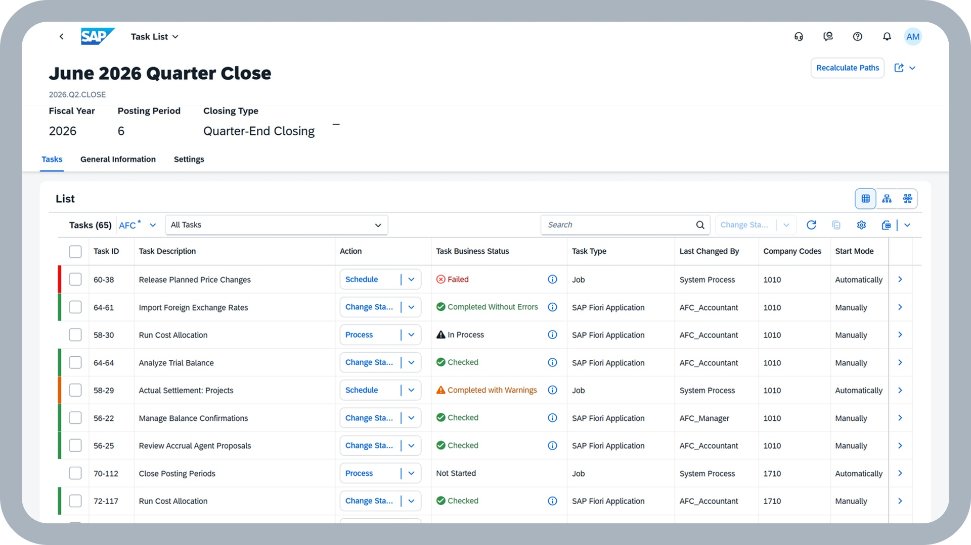
The financial close evolves from a sequence of isolated tasks to a process orchestrated from a centralized, real-time control tower.
4. Towards 'Continuous Accounting': Key Closing Simplifications
SAP S/4HANA drives the Continuous Accounting model, where the close is no longer a traumatic period-end event but a continuous state. Through SAP Fiori applications, it is possible to perform a 'Soft Close,' obtaining trial balances and income statements at any time during the month.
This dynamism is supported by three key innovations:
- Event-based revenue recognition: Replaces month-end valuation steps with real-time, transaction-based valuation, bringing forward the visibility of actual profitability.
- Real-time depreciation: Fixed asset valuation no longer depends on massive month-end batch processes; values are updated with every movement, eliminating technological bottlenecks.
- Transparent Balance Carryforward: This process now generates documents with status 'C' in the Universal Journal. This ensures an impeccable audit trail for the opening balances of the new fiscal year, eliminating the opacity of traditional systems.
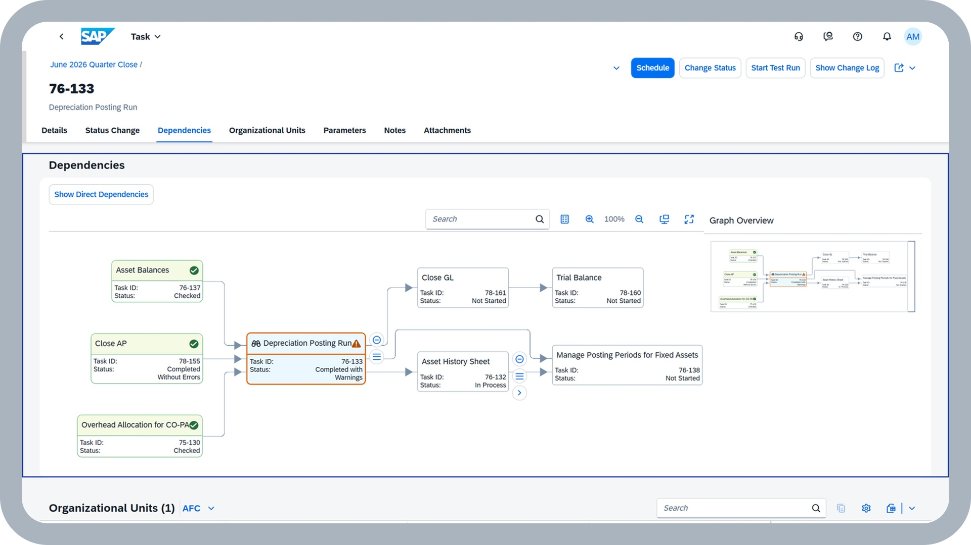
SAP S/4HANA drives the Continuous Accounting model, transforming the close from a traumatic period-end event into a continuous state.
5. Analysis and Reporting: Data-Driven Decisions, Not Process-Driven
The power of SAP HANA eliminates the need to asynchronously replicate data into a Business Warehouse (SAP BW) for standard financial reporting. Information is now live and multidimensional.
- Line-item level analysis: The system aggregates millions of records from the ACDOCA table in seconds, allowing total flexibility to filter and drill down into data without needing predefined indexes.
- Extensibility and CDS Views: The CFO can adapt the system to the specific analytical dimensions of their business (Coding Block). Most importantly from a strategic standpoint, through CDS Views (Core Data Services), any new business field or dimension is automatically integrated into reports and analytical apps, drastically reducing IT dependency and maintenance costs.
6. Conclusion: The Close as a Competitive Advantage
The transition to SAP S/4HANA is not a technical upgrade; it is an operational paradigm shift. Historically, accounting has acted as a 'repair shop' for poorly configured processes at the source. With the open-concept architecture and the Single Source of Truth, the system makes it possible to correct data quality at the exact moment of creation.
This frees the CFO from data 'mechanic' duties and positions them as the strategic 'navigator' of the organization. By ensuring information integrity from its origin, the financial close ceases to be an administrative burden and transforms into the engine of strategic information that every modern enterprise needs to compete in the digital age.
This frees the CFO from data mechanic duties and positions them as the strategic navigator of the organization.